
In modern tactical analysis, few concepts are as revered—or as demanding to execute—as the intentional creation of positional overloads. For the past twelve months, Chelsea’s expensively assembled squad operated with erratic brilliance, capable of explosive individual flashes but regularly crippled by structural imbalance and defensive disorganization. Enter Enzo Maresca. Guided by a rigid positional philosophy honed alongside Pep Guardiola, Maresca has instituted tactical clarity at Stamford Bridge. At the epicenter of this resurgence is the masterful spatial decoupling of Cole Palmer, operating within an intricate 3-2-4-1 in-possession blueprint.
Rather than confining Palmer to the right touchline or saddling him with conventional central midfield defensive tracking, Maresca has sculpted an ecosystem specifically designed to maximize his vision, spatial awareness, and lethal decision-making in the final third.
The Inversion Mechanism: How Cucurella and Gusto Build the 3-2 Base
To grant attacking playmakers tactical freedom, a team must first establish defensive equilibrium behind the ball. Maresca accomplishes this by instructing his fullbacks—principally Marc Cucurella on the left or Malo Gusto on the right—to abandon the touchline in possession and invert directly into the central midfield pivot alongside Moisés Caicedo or Roméo Lavia.
This subtle tactical shift fundamentally transforms Chelsea’s base shape from a standard 4-2-3-1 into a compact 3-2-4-1:
- Central Numerical Superiority: By pushing a fullback into midfield, Chelsea create a 4v3 or 3v2 overload against opposition midfield screens, forcing the opponent to either compress centrally or surrender passing lanes into the forwards.
- Immediate Rest-Defense Shielding: Inverted fullbacks occupy the exact central spaces where counter-attacks are typically launched, enabling immediate counter-pressing within three seconds of a turnover.
- Flank Isolation for Pure Wingers: With the fullbacks positioned centrally, natural wide players like Noni Madueke or Pedro Neto hold maximum touchline width, pinning opposition fullbacks and creating vast expanses in the intermediate half-spaces.
The Right Half-Space Sanctuary: Palmer’s Cognitive Advantage
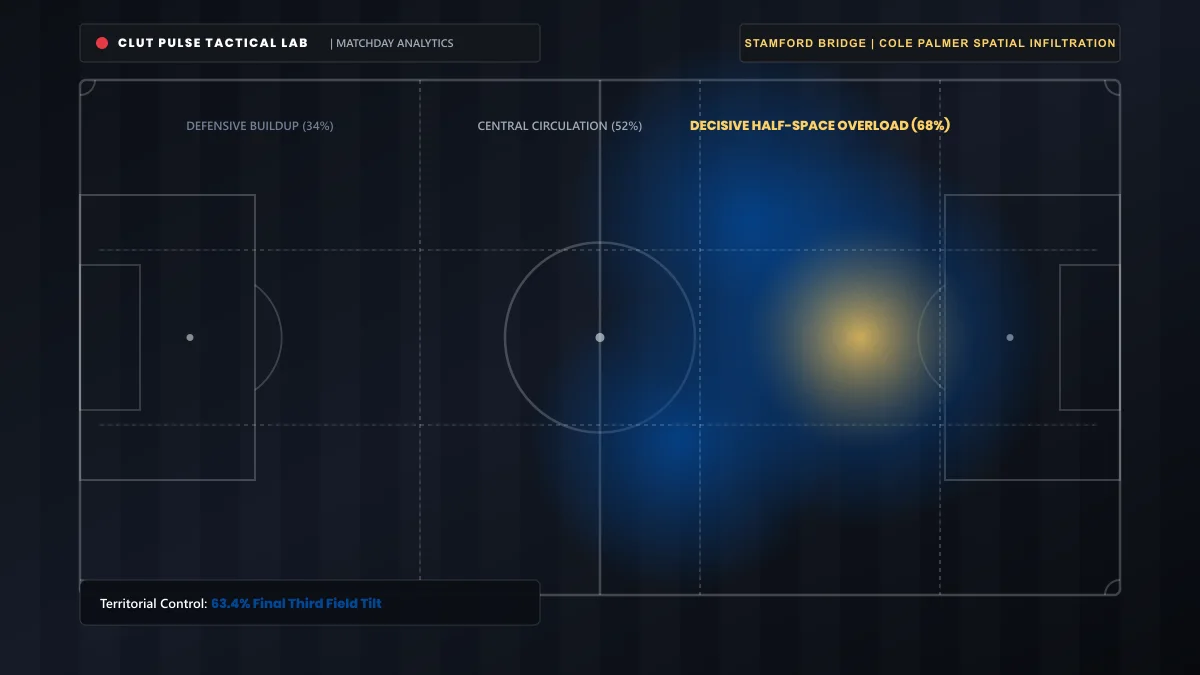
With Chelsea’s structural framework commanding the opponent’s defensive attention, Cole Palmer is gifted the ultimate luxury in top-flight football: time and spatial ambiguity. Operating between the opponent's defensive line and midfield block, Palmer drifts laterally across a ten-yard corridor known as the right half-space.
Opposing defenses face an unsolvable tactical dilemma. If an opponent center-back steps out to challenge Palmer, Nicolas Jackson exploits the vacated depth with a blind-side channel run. If the opponent defensive midfielder drops deep to shadow him, Caicedo or Enzo Fernández can stride forward into unoccupied central shooting zones unpressured. Palmer’s scanning frequency—routinely exceeding 0.65 scans per second prior to receiving the ball—ensures he executes the optimal action before the defense can converge.
Performance Metrics: Palmer and Chelsea Under Maresca
The empirical evidence supporting Chelsea’s tactical efficiency under Maresca demonstrates a marked improvement across all key performance indicators:
- Expected Assists (xA) per 90: Palmer registers 0.48 xA per 90 minutes, ranking in the 98th percentile among all Premier League attacking midfielders.
- Progressive Passes Received: 6.2 progressive passes received per match, reflecting how consistently Chelsea’s backline finds him behind opposition pressing lines.
- Territorial Field Tilt: Chelsea hold a 68.4% share of final-third possession, demonstrating sustained pressure rather than reliance on counter-attacking bursts.
- High Turnovers Generated: Maresca’s rest-defense structure has produced 14 shots originating directly from turnovers won within 40 meters of the opposition goal.
Third-Man Combinations: Releasing Nicolas Jackson and Madueke
Palmer’s individual genius is magnified by Chelsea’s automated third-man combination patterns. One of Maresca’s signature attacking moves involves a direct vertical pass from the central defender into Nicolas Jackson’s feet. Rather than attempting a low-percentage swivel, Jackson cushions the ball backward into Palmer’s path on a single touch.
Because Palmer arrives facing forward with the entire pitch in front of him, he can dissect the retreating defensive line with laser precision—either slipping a diagonal through-ball to Madueke cutting inside or curling a trademark left-footed strike toward the far corner. These choreographed sequences remove guesswork from Chelsea's attacking play, substituting erratic improvisation with repeatable tactical excellence.
"Cole is a player who sees things two seconds before anyone else on the pitch. Our job as a coaching staff is to construct the structure that allows him to receive the ball in his preferred zones without being surrounded by three defenders. When the team respects the positional discipline, Cole's quality will win football matches."
— Enzo Maresca, Post-Match Press Briefing
Managing Structural Risk: Preventing Transitions in Behind
No tactical system is devoid of vulnerabilities. The primary drawback of committing inverted fullbacks and maintaining a high defensive line is the space left behind the wide center-backs. When an opponent successfully bypasses Chelsea’s initial counter-press, their wide forwards can exploit the channels behind Levi Colwill and Wesley Fofana.
Maresca has addressed this risk by demanding absolute tactical foul awareness and rapid athletic recoveries from Caicedo. When the pressing trap functions properly, Chelsea snuff out transitions before they gain momentum; when it falters, Chelsea must rely on Robert Sánchez’s sweeping capabilities outside his 18-yard box.
Conclusion: The Emergence of a Genuine Contender
Chelsea’s journey toward tactical maturity remains an ongoing project, but the foundational architecture is firmly established. By combining Enzo Maresca’s tactical rigor with Cole Palmer’s generational half-space artistry, the Blues have transformed from a collection of talented individuals into a coherent, formidable collective capable of dismantling the most stubborn defensive structures in English football.

Discussion