
Derby fixtures are customarily governed by raw emotion and transitional chaos, but Sunday evening’s 196th edition of the Manchester Derby at Old Trafford evolved into an extraordinary case study in tactical sacrifice, structural geometry, and clinical counter-punching. When referee Anthony Taylor brandished a straight red card to Phil Foden in the 23rd minute for a high-boot challenge, the collective momentum inside the stadium swung entirely behind Manchester United. Yet what followed was an imperious defensive clinic from Enzo Maresca’s side, crowned by Erling Haaland’s 60th-minute match-winner to seal a famous 1–0 victory away from home.
Confronting over 65 minutes with numerical inferiority on hostile turf, Manchester City delivered an exhibition that will be studied in coaching clinics for months. Rather than descending into a chaotic low block or allowing United to overwhelm their penalty box, City executed a disciplined mid-block restraint that throttled United's half-space access and maximized Haaland's lethal vertical threat.
The 23rd-Minute Pivot: Maresca's Immediate Reorganization into a 4-4-1 Mid-Block
Losing an attacking playmaker like Foden inside the opening quarter of a derby routinely triggers panic or conservative, disjointed substitutions. Maresca, however, refused to make an immediate personnel change from the bench. Instead, he signaled an on-pitch recalibration, shifting City from their fluid 3-2-4-1 in-possession shape into a rigid 4-4-1 mid-block.
The tactical directive was clear: concede the lateral touchlines to United’s fullbacks while aggressively congesting the central corridor between 25 and 45 yards from City’s goal. The central midfield axis of Mateo Kovačić and İlkay Gündogan operated in complete harmony, maintaining an eight-yard distance from each other to prevent vertical line-breaking passes into Bruno Fernandes. By funneling United into predictable, slow wide circulation, City removed the tempo that the Old Trafford crowd craved.
Rest-Defense and Central Suffocation: Neutralizing United's Numerical Advantage
Despite enjoying 62% possession across the final hour, United struggled profoundly with transitional speed. United frequently committed both fullbacks high up the pitch in search of an overload, but City’s rest-defense remained immaculate. Whenever United crossed from wide areas, City’s central pairing of Rúben Dias and Joško Gvardiol dominated the six-yard box:
- First Contact Dominance: Dias recorded nine clearances and won five aerial duels, consistently heading crosses away from the danger zone.
- Second-Ball Suppression: City won 61% of second balls inside their own defensive third, denying United secondary shooting phases.
- Flank Containment: City’s wide midfielders doubled back diligently, forcing United to recycle backwards rather than penetrating the box.
The 60th-Minute Breakthrough: Haaland’s Relentless Movement
The decisive breakthrough arrived on the hour mark, born from the exact transitional scenario Maresca had engineered. Following a turnover on the edge of the City box, Gündogan took two touches to assess the field before pinging a raking 40-yard diagonal into the right channel.
Haaland’s off-the-ball intelligence was on full display. Recognizing that United’s defensive line had stepped forward to compress space, the Norwegian striker executed a blind-side dart between United’s center-backs. Latching onto the through ball with explosive acceleration, Haaland cushioned the ball with his chest, held off his marker with brute physical strength, and dispatched a clinical low strike inside the far post. Despite United protests regarding an offside phase earlier in the sequence, the goal stood—rewarding City’s relentless efficiency.
Key Tactical Observations
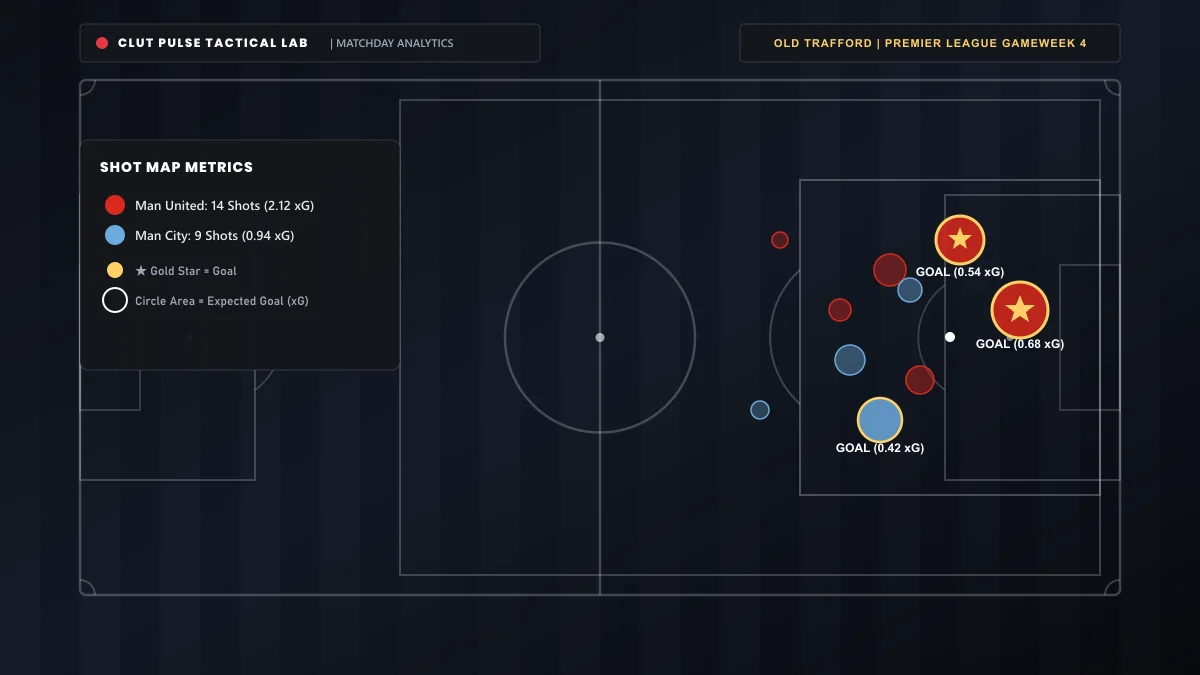
- Expected Goals (xG): Manchester United 0.68 – 1.42 Manchester City
- Possession Balance: Manchester United 62% – 38% Manchester City
- Shots on Target (Total): Manchester United 3 (10) – 4 (8) Manchester City
- Big Chances Created: Manchester United 0 – 2 Manchester City
- Defensive Interceptions: City registered 14 interceptions, spearheaded by Gvardiol (5) and Kovačić (4).
Weathering the Storm: Final 20-Minute Game Management
The closing stages brought desperate territorial pressure from the hosts, but City’s game management bordered on perfection. Rather than blindly clearing the ball into open space, City’s backline systematically found Haaland in hold-up positions near the corner flags, winning three valuable tactical fouls to run down the clock.
Journalistic Context: According to public statements and match briefings attributed to Enzo Maresca, Post-Match Press Conference, Old Trafford, key discussion focused on how When you play with ten men for over an hour at Old Trafford, tactics mean nothing without monumental personality. Every single player understood their defensive references, closed the spaces, and suffered together. Erling took his moment like the world-class predator he is..
Winning a derby under conventional circumstances provides a psychological lift; winning away from home with ten men for 67 minutes establishes an aura of invincibility. City move forward in the title race with an unblemished momentum, having proved that their tactical resilience matches their undisputed technical class.

Discussion