
Uganda’s journey toward commercial petroleum production achieved a historic milestone in August 2026, as total physical progress on the 1,443 km East African Crude Oil Pipeline (EACOP) officially crossed 91% completion.
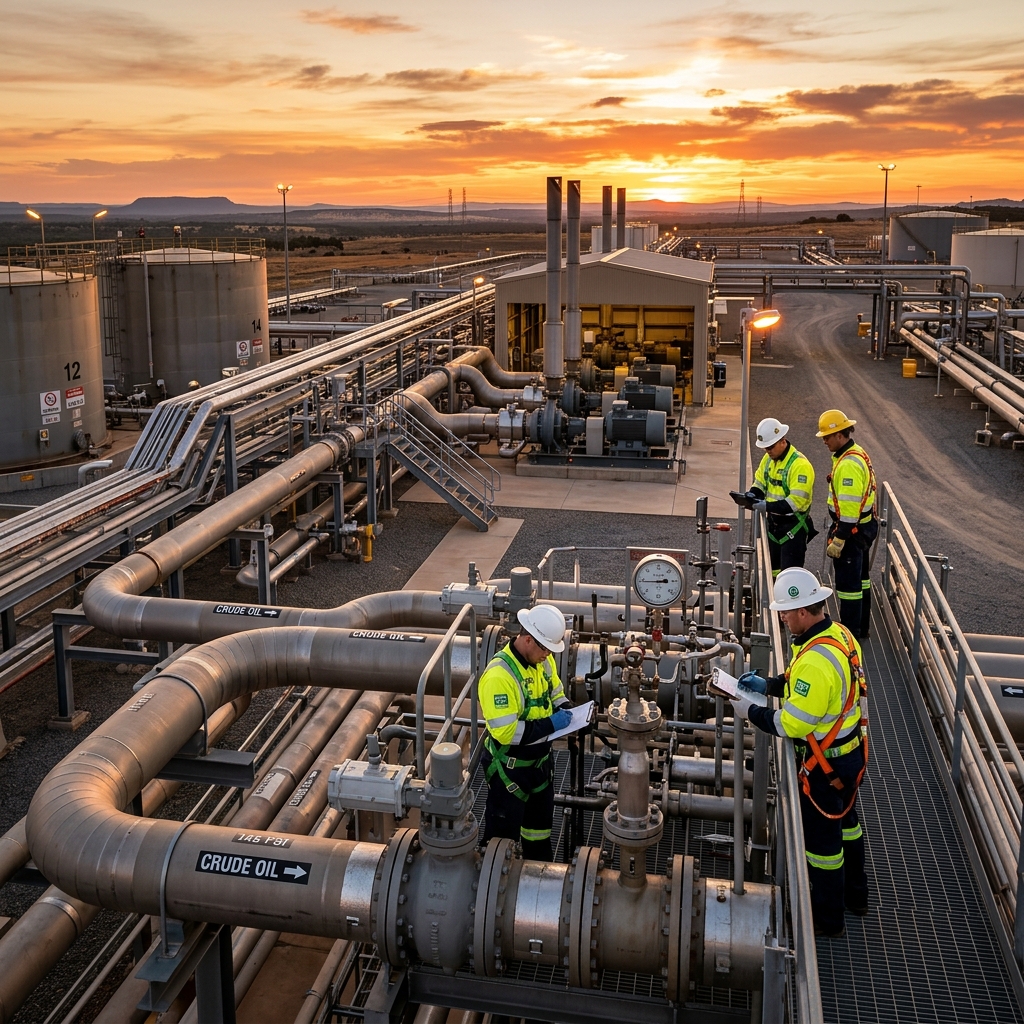
The landmark announcement coincided with a high-level inspection tour conducted on August 7, 2026, led by Uganda’s Chief Justice, the Governor of the Bank of Uganda, energy ministry leaders, and financial regulators at Pump Station 1 (PS-1) located in Kabaale, Hoima District.
Inspection Tour of Pump Station 1 in Hoima
During the Hoima site visit, delegates inspected the completed civil foundation works, crude oil thermal insulation wrapping systems, main electrical power substations, and automated control centers. PS-1 serves as the master intake point where crude oil extracted from TotalEnergies’ Tilenga project and CNOOC’s Kingfisher field will be gathered, metered, and heated before entering the world's longest electrically heated crude oil pipeline.
Project engineers briefed judicial and financial leaders on the advanced technical specifications of the pipeline, which features real-time fiber-optic leak detection sensors, solar-powered cathodic protection units, double-walled insulation, and buried piping designed to maintain crude fluid temperatures at 50°C across its entire transit path.
Regional Progress Across Uganda and Tanzania
The EACOP development spans 296 km through 10 districts in Uganda before crossing into Tanzania for 1,147 km to terminate at the marine export storage terminal at Tanga Port. Technical updates confirm that civil engineering across all six pumping stations—including Pump Station 3 in Tanzania’s Kagera Region (now at 88% completion)—is virtually finished.
Over 1,200 km of high-grade steel pipe segments have already been welded, factory-insulated, and lowered into trenches across both host nations. Special commissioning teams have commenced hydrostatic pressure testing, valve testing, and electrical control cabling in preparation for initial crude oil line fill operations.
Advanced Environmental Technology and Safety Standards
EACOP is engineered with state-of-the-art environmental safeguards designed to meet international IFC performance standards. The pipeline is buried at a minimum depth of 1.8 meters across its entire length to allow unimpeded surface land use by local farming communities.
Furthermore, automated emergency shut-off valves are strategically placed every 10 km, capable of isolating pipeline segments within seconds in the event of pressure anomalies. Continuous satellite surveillance and drone monitoring systems provide 24/7 oversight across both host countries.
"Reaching 91% completion on EACOP is a monumental victory for Uganda and Tanzania," remarked the Bank of Uganda delegation leader. "This infrastructure represents energy independence, industrial transformation, national revenue expansion, and thousands of skilled technical jobs for East African youth."
Socio-Economic Impact and Local Content Growth
The EACOP development has injected hundreds of millions of dollars directly into local business ecosystems through subcontracts for civil engineering, transport logistics, catering, environmental monitoring, and security services. Over 85% of the total workforce employed on the Ugandan section consists of Ugandan nationals, supported by specialized technical training programs in Hoima and Kicuuba.
Environmental management teams emphasized that the pipeline path was meticulously engineered to minimize social and ecological impact, utilizing trenchless horizontal directional drilling (HDD) to cross sensitive river basins such as the Victoria Nile without disturbing delicate aquatic ecosystems.
Macroeconomic Impact and Revenue Generation
Beyond construction milestones, EACOP is projected to unlock unprecedented macroeconomic benefits for Uganda's economy. Estimates from the Ministry of Finance indicate that commercial oil production will generate over $1.5 billion annually in government revenues through royalties, corporate income tax, and profit-sharing dividends.
These revenues will be deposited directly into Uganda's Petroleum Fund, dedicated to financing national capital investments in renewable energy, healthcare infrastructure, secondary education, and agricultural modernizing programs across all sub-regions.
Targeting "First Oil" Production in 2026
With main pipeline construction at 91% and construction on the Hoima central processing facility advancing rapidly, joint venture partners TotalEnergies, CNOOC, Uganda National Oil Company (UNOC), and Tanzania Petroleum Development Corporation (TPDC) remain firmly on course to achieve commercial "First Oil" exports within the 2026 operational timeframe.
Discussion